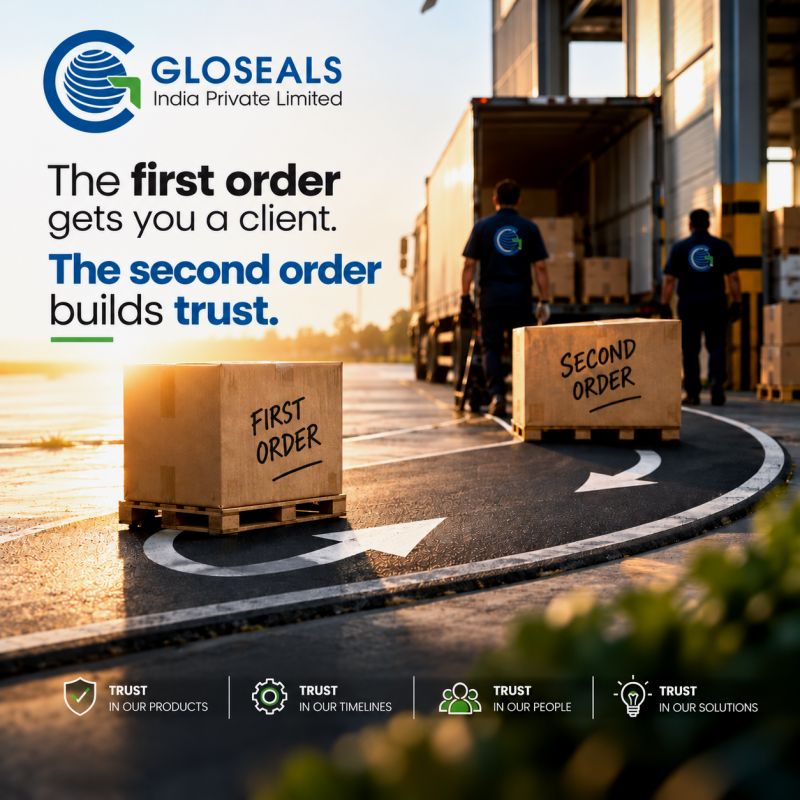
Most manufacturers talk about how many customers, dealers and resellers they serve. Far fewer talk about how many of them came back. Yet repeat business in manufacturing is one of the clearest signs that a supplier delivers on what it promises. A first order shows that a buyer was willing to take a chance. A second order shows that the supplier earned their trust. In this article, we look at what makes B2B buyers return, how to judge a supplier before you order, and how Gloseals India approaches long-term customer relationships.
Why Repeat Business Matters More Than a Long Customer List
A long customer list looks impressive, but it only tells you who bought once. It does not tell you whether the product performed, whether the delivery was on time or whether the supplier was easy to work with when something went wrong.
Repeat orders answer those questions. When a buyer places a second or third order, they have already seen the product in use, experienced the delivery process and dealt with the people behind the company. They are choosing to continue, and that decision carries real information that no brochure can give.
For buyers, this is a useful signal. A supplier with a strong base of returning customers has usually solved the problems that matter in industrial purchasing: consistent quality, dependable lead times and honest communication.
First Order vs Second Order: What Really Changes
The first order is usually a decision made on limited information. The buyer may have compared quotations, checked a website, asked for samples or relied on a recommendation. There is always some risk involved.
By the second order, that risk has been replaced by experience. The buyer knows how the product behaves on the floor, how the supplier handles queries, and whether the promised timeline was kept. The second order is not about price alone. It is about confidence.
This is why many experienced procurement teams prefer to stay with a proven supplier even when a slightly cheaper quote is available. The cost of a failed product, a delayed shipment or a stalled project is almost always higher than the saving on paper.
What Brings B2B Buyers Back to a Manufacturer
1. Products That Perform in Real Conditions
Industrial products are used in tough conditions: heavy vehicles, constant footfall, outdoor weather, vibration and impact. A product that looks good on a datasheet but fails on site will not earn a repeat order. Buyers return when the product keeps doing its job month after month, with no surprises.
2. Timelines That Are Kept
For contractors, facility managers and project teams, a late delivery can hold up an entire schedule. Reliable timelines are often valued as highly as the product itself. When a supplier says a consignment will arrive by a certain date and it does, that builds trust order after order.
3. People Who Respond and Take Ownership
Behind every order is a team that answers queries, shares drawings, confirms specifications and follows up on dispatch. Buyers remember who picked up the phone and who solved the problem instead of passing it along. Good communication is one of the most underrated reasons customers return.
4. Support When Things Do Not Go as Planned
No supplier gets every order perfect. Sizes change at the last minute, site conditions turn out different from the drawing, or a requirement is clarified late. What separates a trusted supplier from an ordinary one is how it responds. Buyers come back to companies that take responsibility and work towards a solution.
Customisation: A Strong Driver of Long-Term Relationships
Standard products solve many problems, but real sites rarely match a catalogue exactly. A loading bay may need a specific size of bumper, a warehouse may need a certain colour for zone marking, or a project may need a product adapted to an unusual layout.
Suppliers who can customise rubber and plastic products to the customer's size, colour or specific requirement become far more valuable to their buyers. Instead of forcing a compromise, they work from the application backwards. That kind of collaboration is hard to replace, which is why customisation often leads to repeat orders and long-term partnerships.
When you speak to a manufacturer about custom requirements, it helps to share:
- The application and the environment in which the product will be used
- Required dimensions, quantities and any tolerance limits
- Colour or visibility needs, such as safety marking
- The type of load, impact or traffic the product will face
- Delivery timelines and the site location
Rubber and Plastic Solutions Across Applications
Gloseals India manufactures rubber and plastic products for workplaces, warehouses, roads and parking areas. Different applications call for different products, and a supplier with a broad range can often meet several needs in a single relationship.
- Cable management: The Kovrdo cable protector range covers single-channel to multi-channel options for floors that see people, trolleys and vehicles.
- Vehicle stopping and loading areas: Wheel chocks and wheel stoppers help control vehicle movement. The wheel stoppers are made from high-density SBR rubber.
- Structure protection: Wall guards, corner guards, column guards and dock fenders and bumpers absorb impact from trolleys, vehicles and equipment.
- Traffic control: Speed breakers, traffic cones and convex mirrors help manage movement in industrial and commercial areas.
- Site boundaries: Plastic safety barriers mark work zones, parking areas and event spaces.
- Worker comfort: Fatigo anti-fatigue mats support people who stand for long hours.
How to Evaluate a Rubber Products Supplier Before You Order
If you are choosing a new supplier, you can use the same signals that make buyers stay loyal. Here is a practical checklist.
- Ask for application references. A supplier who has delivered similar products for similar environments can explain how those products have performed.
- Check material and specification clarity. Dimensions, materials and intended use should be stated clearly, not left vague.
- Review certifications. Quality certifications show that processes are documented and followed.
- Test responsiveness early. Notice how quickly and clearly the team answers your first queries. It is usually a good preview of the relationship.
- Discuss lead times honestly. A realistic timeline is better than an optimistic promise.
- Ask about customisation. Even if you do not need it today, flexibility on size and colour shows the supplier can adapt to your needs later.
- Start with a pilot order if needed. A smaller first order lets you judge quality and service before committing to larger volumes.
Questions Worth Asking a Manufacturer
- Can this product be supplied in our required size and colour?
- What is the typical lead time for standard and customised orders?
- How do you handle changes to a specification after the order is placed?
- What support is available if the product needs to be replaced or adjusted?
- Do you supply other products we may need for the same site?
Dealers, Resellers and Long-Term Partnerships
Trust matters just as much in the dealer and reseller channel. A dealer puts their own reputation behind the products they sell. If a product fails or a delivery is missed, their customer blames them first.
That is why reliable dealers stay with manufacturers who keep quality consistent, supply on schedule and respond quickly when queries come in. Over time, a good manufacturer-dealer relationship becomes a shared commitment to the end customer, and that is something both sides have to earn continually.
The Gloseals Approach: Engineered for Real Environments
At Gloseals India, the goal is not to be remembered as just another supplier. The aim is to be the company a buyer thinks of when they need the right rubber solution for their application, whether that is a standard product or something customised to their size, colour or specific requirement.
The company's guiding line, Engineered for real environments, reflects this thinking. Products are designed for the conditions in which they will actually be used, from busy warehouse floors and loading docks to parking structures and outdoor roads. You can learn more about the company on the About Us page and explore its industries served.
For Gloseals, a repeat order is more than another line in an order book. It is a sign that the product worked, the timeline was met and the team was there when needed.
Frequently Asked Questions
Why is repeat business important for a manufacturer?
Repeat business shows that customers were satisfied with the product, the delivery and the service. It is a stronger indicator of quality and reliability than the total number of customers served.
How can I tell if a supplier is reliable?
Look at how clearly they share specifications, how quickly they respond to queries, whether they can provide references for similar applications, and how realistic their lead times are.
Can rubber products be customised?
Yes. Gloseals India can supply products customised to your required size, colour or specific application requirement. Share your drawings or details with the team to discuss options.
Does Gloseals work with dealers and resellers?
Yes. Gloseals works with companies, clients, dealers and resellers. You can contact the team to discuss partnership options.
What information should I share when asking for a custom product?
Share the application, dimensions, quantity, colour requirement, type of load or impact and delivery timeline. The clearer the requirement, the faster a suitable solution can be proposed.
Which Gloseals products are available for industrial use?
The range includes cable protectors, wheel chocks, wall, corner and column guards, dock fenders, speed breakers, safety barriers and anti-fatigue mats.
Build a Supplier Relationship That Lasts
The right supplier does more than deliver a product. They deliver on time, communicate clearly and stand behind their work. If you are looking for a rubber and plastic solutions partner, contact Gloseals India with your requirement and our team will help you find the right product, standard or custom.