Water Filled Safety Barriers: Types & Uses | Gloseals

A comprehensive guide to workplace safety equipment

Blog Detail

Water Filled Safety Barriers: Types & Uses | Gloseals

Learn how water-fillable plastic safety barriers work, where they are used on roads, construction sites and parking areas, and how to choose the right variant.

Introduction

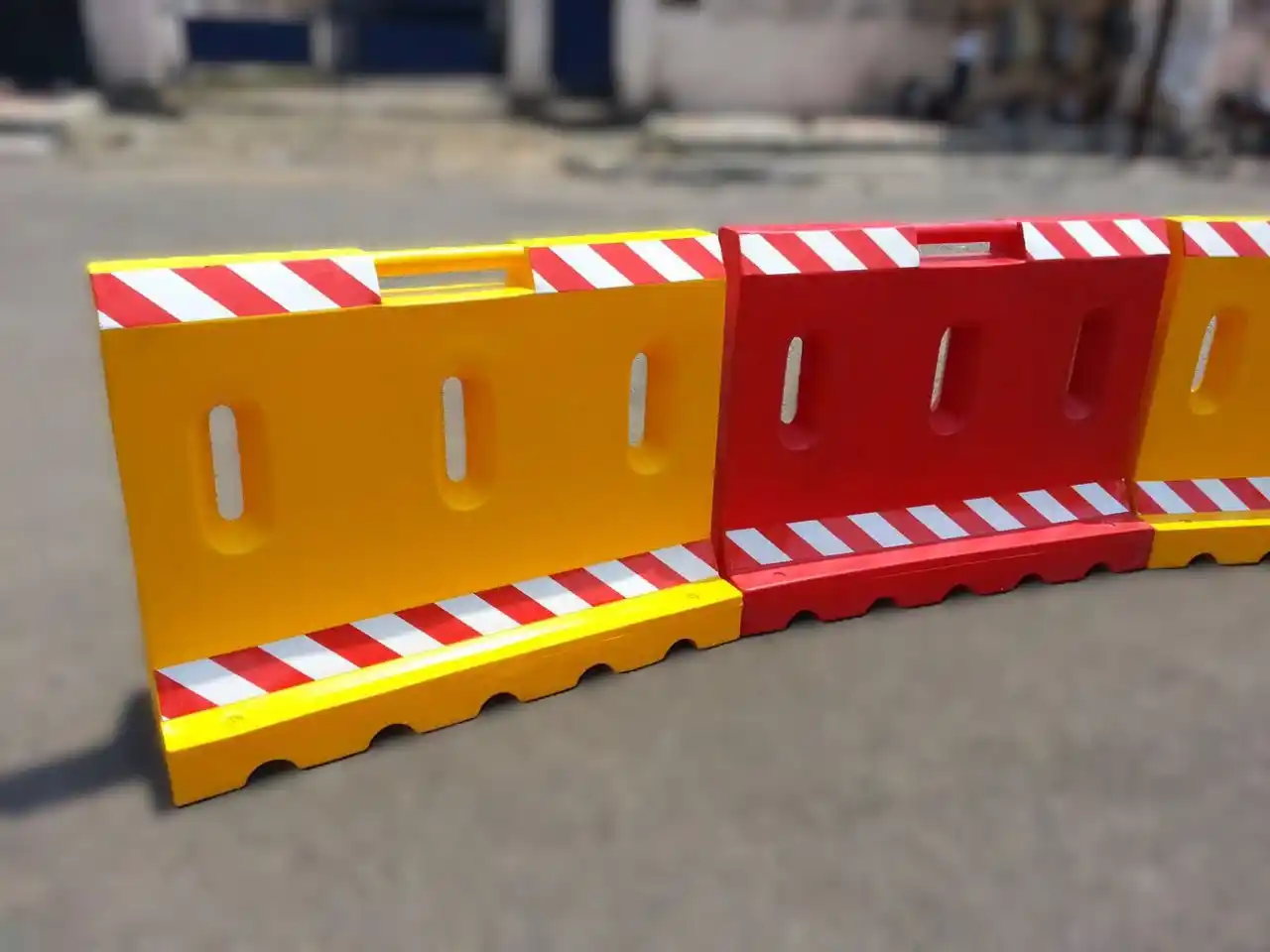
Whether it is a road diversion, a construction zone or a busy parking lot, clearly marked and stable boundaries are what keep people and vehicles apart. Plastic safety barriers from Gloseals India make this easy: they are made from virgin LLDPE/HDPE, fill on-site with water or sand, and are UV stabilized for long outdoor use. In this guide, we explain how water-fillable barriers work, where they are used and how to choose the right variant for your site.

Why Plastic Safety Barriers Are Replacing Traditional Options

For many years, concrete blocks, steel barricades and ad-hoc arrangements of drums and ropes were the standard way to separate traffic from people. They still have their place, but they come with practical problems. Concrete blocks need cranes or heavy machinery to move. Metal barricades rust, bend and need repainting. Drums and ropes are quick to set up but offer little visual clarity and almost no physical stability.

Plastic safety barriers solve most of these problems at once. They are light enough to transport and place by hand, they become stable once filled with water or sand, and they can be drained and moved whenever the layout of a site changes. They do not rust, they do not need painting, and their bright colours keep the boundary visible to drivers and pedestrians alike.

For contractors, facility managers and event organisers who set up and dismantle boundaries often, this flexibility saves both time and labour.

What Is a Water-Fillable Safety Barrier?

A water-fillable safety barrier is a hollow plastic unit that is light when empty and stable when filled. Once it is placed at the required spot, it is filled with water or sand through a fill port. The added weight keeps the barrier in position, and it can be emptied and moved again when needed.

This makes it a practical choice for temporary and semi-permanent setups where fixed structures are not possible or not allowed. A single person can carry an empty barrier to the location, which is a big advantage on sites where machinery cannot reach easily.

Why Rotational Moulding Matters

Gloseals safety barriers are produced by rotational moulding from premium virgin LLDPE/HDPE. In this process, plastic is heated inside a rotating mould so that it coats the inner surface evenly. The result is a hollow, seamless, one-piece body with no welded joints or bolted panels that could become weak points.

This matters in daily use. A seamless body is better suited to hold water or sand without leaking, and the uniform wall helps the barrier cope with the knocks, sun and weather it will face outdoors. Using virgin-grade material, rather than recycled plastic, also supports consistent quality from one unit to the next.

Key Features of Gloseals Safety Barriers

  • LLDPE/HDPE construction: Virgin-grade material, rotational moulded for a strong, one-piece body.
  • Water or sand fillable: Choose the fill based on site conditions and the stability required.
  • UV stabilized: Designed to resist fading and degradation from long exposure to sunlight, which is important for Indian conditions.
  • High visibility colours: Bright colours that stay clearly visible to drivers and pedestrians, including in low light.
  • Interlocking design: Units connect to form a continuous line with no gaps for people or vehicles to slip through.
  • Maintenance free: No painting, no rust and no regular upkeep beyond basic cleaning.
  • Weather resistant: Built for long-term outdoor use in sun, rain and dust.

Where Are Plastic Safety Barriers Used?

Road Works and Highways

On road maintenance and highway projects, barriers separate moving traffic from work zones, guide vehicles around diversions and mark lane closures clearly. Because they are quick to place, work crews can set up a safe zone at the start of a shift and clear it away when the work ends.

Construction and Industrial Sites

Construction sites have constant movement of trucks, loaders and workers. Barriers keep pedestrians away from excavation, material storage and machinery paths. Inside factories and warehouses, they can mark walkways, restrict access to hazardous areas and separate forklift routes from foot traffic.

Parking Lots and Basements

In parking areas, barriers guide vehicle flow, block off restricted or reserved bays and protect pedestrian walkways. For protecting walls and guiding vehicles to stop at the right point, they work well alongside wall guards and wheel stoppers.

Events, Malls and Public Spaces

For exhibitions, concerts, sports events and public gatherings, barriers define zones quickly and can be rearranged as the event layout changes. For queue management inside buildings, such as banks, airports and malls, queue managers are a better fit and can be used together with outdoor barriers at entry points.

Perimeter and Security Areas

Taller variants, such as the fence and security models, can be used to mark perimeters around temporary sites, restricted zones and storage yards where height and visual deterrence matter.

Gloseals Safety Barrier Range

Gloseals offers eight variants so that you can match the barrier to the job instead of compromising on a single size.

VariantDimensions (mm)Weight
GSB-1M (Standard)1000 x 350 x 10008-10 Kg
GSB-1ML (L Shape)1000 x 350 x 7508 Kg
GSB-1MNE (Nestable)1000 x 500 x 8509 Kg
GSB-2M (Heavy Duty)2000 x 550 x 85014-18 Kg
GSB-2MHD (Jumbo)2000 x 550 x 100018-22 Kg
GSB-2.5EX (Expandable)2500 Open / 800 Closed10 Kg
GSB-FENCE (Fence)2160 x 400 x 120015 Kg
GSB-MGL (Security)2000 x 425 x 150018 Kg

Weights shown are empty weights.

Standard and L Shape (GSB-1M, GSB-1ML)

The 1-metre standard barrier is the all-round choice for short diversions, parking areas and general site use. The L-shape version has a lower profile at 750 mm height, which suits places where a lower barrier is enough or where visibility over the top is needed.

Nestable (GSB-1MNE)

The nestable design is made for easy storage and transport. If you set up and dismantle barriers regularly, being able to store more units in less space reduces handling and transport effort.

Heavy Duty and Jumbo (GSB-2M, GSB-2MHD)

These 2-metre units cover more length with fewer pieces, which speeds up installation on long runs. The jumbo version adds extra height for a stronger visual boundary.

Expandable (GSB-2.5EX)

This variant opens to 2500 mm and closes to 800 mm. It is useful where you need flexible coverage and compact storage, such as for events and temporary closures.

Fence and Security (GSB-FENCE, GSB-MGL)

With heights of 1200 mm and 1500 mm, these taller models are designed for perimeter marking and security-oriented use where a higher barrier is preferred.

How to Choose the Right Safety Barrier

  • Standard sites (GSB-1M, GSB-1ML): General road work, parking and short diversions.
  • Limited storage space (GSB-1MNE, GSB-2.5EX): The nestable and expandable designs take less room when stored or transported.
  • Longer runs and higher stability (GSB-2M, GSB-2MHD): The 2-metre units cover more length with fewer pieces.
  • Perimeter and security use (GSB-FENCE, GSB-MGL): Taller profiles for areas where height and visual deterrence matter.

Before ordering, think through these questions:

  • How long is the run you need to cover, and how many units does that require?
  • Will the barrier stay in one place for months, or be moved every few days?
  • Is the site exposed to strong wind, or located near fast-moving traffic?
  • How much storage and transport space is available between uses?
  • Do you need a low, medium or tall barrier for the purpose?

Also check the traffic and site safety guidelines that apply to your project, since requirements can differ by road type and authority.

Water vs Sand Filling

Both options work, and the right choice depends on the site.

  • Water: Easy to fill and drain, and available almost everywhere. It suits temporary setups where barriers are moved often.
  • Sand: Heavier than water for the same volume, which adds stability in windy or higher-risk locations. It is better for longer installations where the barrier will not be moved frequently.

Whichever fill you use, close the fill port properly after filling. In places where temperatures fall low enough to freeze water, sand is the safer option. Always drain or empty the barrier before lifting it, since a filled unit is far too heavy to carry.

Installation Tips for Better Site Safety

  1. Plan the layout first. Mark where the barrier line will run, including turns and gaps for authorised access.
  2. Place on level ground. A flat, firm surface keeps the barriers stable once they are filled.
  3. Position before filling. Place each empty barrier at its final spot, then fill it. Moving a filled barrier is difficult.
  4. Fill completely. A partly filled barrier is less stable, so fill each unit to the recommended level.
  5. Interlock the units. Connect neighbouring barriers so they act as one continuous line with no gaps.
  6. Add visibility aids. At night or in low light, combine the barrier line with traffic cones, warning lights or reflective signs.
  7. Inspect regularly. Check the line at the start of each shift for displaced units, loose fill caps or damage.

Maintenance and Storage

One of the biggest advantages of plastic barriers is how little care they need. There is no rust to treat and no paint to refresh. A wash with water and mild detergent removes dust and grime and keeps the bright colours clearly visible.

When a barrier is no longer needed on site, drain it fully, let it dry and store it away from heavy objects that could deform it. Nestable and expandable variants make this easier by taking up less space. Check the fill cap and body for cracks or damage before reusing the barrier at the next site.

Plastic vs Concrete vs Metal Barriers

FactorPlastic (Water/Sand Filled)ConcreteMetal
HandlingLight when empty, easy to move by handNeeds machineryModerate, depends on size
Setup timeQuickSlowModerate
Rust and paintingNoneSurface wear over timeProne to rust, needs repainting
VisibilityHigh-visibility colours built inNeeds paint or markingsNeeds paint or markings
ReusabilityDrain, move and reuseDifficult to relocateReusable
StorageCompact options availableBulkyBulky

For permanent, high-speed crash protection, fixed structures may still be required. For temporary and flexible boundaries, plastic barriers are usually the more practical option.

Pair Barriers With Other Safety Products

A barrier works best as part of a complete layout. Combine it with traffic cones for lane guidance, speed breakers to slow vehicles near work zones, and convex mirrors at blind corners. Inside warehouses and factories, corner guards and column guards protect structures, while barriers keep people away from vehicle routes.

Frequently Asked Questions

What are plastic safety barriers made of?

Gloseals safety barriers are made from virgin LLDPE/HDPE and produced by rotational moulding for a seamless, durable body.

Can I fill the barrier with sand instead of water?

Yes. Both water and sand are suitable fill options. Sand gives extra weight where more stability is needed.

Are these barriers suitable for outdoor use?

Yes. They are UV stabilized and weather resistant, and need no painting or regular maintenance.

Can the barriers be connected together?

Yes. The interlocking design lets multiple units form a continuous line.

How many people are needed to install them?

Because the barriers are light when empty, one or two people can usually place them. Once filled, they should not be lifted.

Can I reuse the barriers at different sites?

Yes. Drain the barrier, move it to the new location and fill it again. This reusability is one of the main advantages over fixed structures.

Which variant should I choose?

It depends on the run length, height required and storage space. Our team can help you pick the right model for your site.

Get the Right Safety Barrier for Your Site

Every site has different traffic, space and safety needs. Share your site type and requirement, and our team will suggest the right variant and quantity. View the Safety Barrier range or contact Gloseals India for a quote.

Introduction

Whether it is a road diversion, a construction zone or a busy parking lot, clearly marked and stable boundaries are what keep people and vehicles apart. Plastic safety barriers from Gloseals India make this easy: they are made from virgin LLDPE/HDPE, fill on-site with water or sand, and are UV stabilized for long outdoor use. In this guide, we explain how water-fillable barriers work, where they are used and how to choose the right variant for your site.

Why Plastic Safety Barriers Are Replacing Traditional Options

For many years, concrete blocks, steel barricades and ad-hoc arrangements of drums and ropes were the standard way to separate traffic from people. They still have their place, but they come with practical problems. Concrete blocks need cranes or heavy machinery to move. Metal barricades rust, bend and need repainting. Drums and ropes are quick to set up but offer little visual clarity and almost no physical stability.

Plastic safety barriers solve most of these problems at once. They are light enough to transport and place by hand, they become stable once filled with water or sand, and they can be drained and moved whenever the layout of a site changes. They do not rust, they do not need painting, and their bright colours keep the boundary visible to drivers and pedestrians alike.

For contractors, facility managers and event organisers who set up and dismantle boundaries often, this flexibility saves both time and labour.

What Is a Water-Fillable Safety Barrier?

A water-fillable safety barrier is a hollow plastic unit that is light when empty and stable when filled. Once it is placed at the required spot, it is filled with water or sand through a fill port. The added weight keeps the barrier in position, and it can be emptied and moved again when needed.

This makes it a practical choice for temporary and semi-permanent setups where fixed structures are not possible or not allowed. A single person can carry an empty barrier to the location, which is a big advantage on sites where machinery cannot reach easily.

Why Rotational Moulding Matters

Gloseals safety barriers are produced by rotational moulding from premium virgin LLDPE/HDPE. In this process, plastic is heated inside a rotating mould so that it coats the inner surface evenly. The result is a hollow, seamless, one-piece body with no welded joints or bolted panels that could become weak points.

This matters in daily use. A seamless body is better suited to hold water or sand without leaking, and the uniform wall helps the barrier cope with the knocks, sun and weather it will face outdoors. Using virgin-grade material, rather than recycled plastic, also supports consistent quality from one unit to the next.

Key Features of Gloseals Safety Barriers

  • LLDPE/HDPE construction: Virgin-grade material, rotational moulded for a strong, one-piece body.
  • Water or sand fillable: Choose the fill based on site conditions and the stability required.
  • UV stabilized: Designed to resist fading and degradation from long exposure to sunlight, which is important for Indian conditions.
  • High visibility colours: Bright colours that stay clearly visible to drivers and pedestrians, including in low light.
  • Interlocking design: Units connect to form a continuous line with no gaps for people or vehicles to slip through.
  • Maintenance free: No painting, no rust and no regular upkeep beyond basic cleaning.
  • Weather resistant: Built for long-term outdoor use in sun, rain and dust.

Where Are Plastic Safety Barriers Used?

Road Works and Highways

On road maintenance and highway projects, barriers separate moving traffic from work zones, guide vehicles around diversions and mark lane closures clearly. Because they are quick to place, work crews can set up a safe zone at the start of a shift and clear it away when the work ends.

Construction and Industrial Sites

Construction sites have constant movement of trucks, loaders and workers. Barriers keep pedestrians away from excavation, material storage and machinery paths. Inside factories and warehouses, they can mark walkways, restrict access to hazardous areas and separate forklift routes from foot traffic.

Parking Lots and Basements

In parking areas, barriers guide vehicle flow, block off restricted or reserved bays and protect pedestrian walkways. For protecting walls and guiding vehicles to stop at the right point, they work well alongside wall guards and wheel stoppers.

Events, Malls and Public Spaces

For exhibitions, concerts, sports events and public gatherings, barriers define zones quickly and can be rearranged as the event layout changes. For queue management inside buildings, such as banks, airports and malls, queue managers are a better fit and can be used together with outdoor barriers at entry points.

Perimeter and Security Areas

Taller variants, such as the fence and security models, can be used to mark perimeters around temporary sites, restricted zones and storage yards where height and visual deterrence matter.

Gloseals Safety Barrier Range

Gloseals offers eight variants so that you can match the barrier to the job instead of compromising on a single size.

VariantDimensions (mm)Weight
GSB-1M (Standard)1000 x 350 x 10008-10 Kg
GSB-1ML (L Shape)1000 x 350 x 7508 Kg
GSB-1MNE (Nestable)1000 x 500 x 8509 Kg
GSB-2M (Heavy Duty)2000 x 550 x 85014-18 Kg
GSB-2MHD (Jumbo)2000 x 550 x 100018-22 Kg
GSB-2.5EX (Expandable)2500 Open / 800 Closed10 Kg
GSB-FENCE (Fence)2160 x 400 x 120015 Kg
GSB-MGL (Security)2000 x 425 x 150018 Kg

Weights shown are empty weights.

Standard and L Shape (GSB-1M, GSB-1ML)

The 1-metre standard barrier is the all-round choice for short diversions, parking areas and general site use. The L-shape version has a lower profile at 750 mm height, which suits places where a lower barrier is enough or where visibility over the top is needed.

Nestable (GSB-1MNE)

The nestable design is made for easy storage and transport. If you set up and dismantle barriers regularly, being able to store more units in less space reduces handling and transport effort.

Heavy Duty and Jumbo (GSB-2M, GSB-2MHD)

These 2-metre units cover more length with fewer pieces, which speeds up installation on long runs. The jumbo version adds extra height for a stronger visual boundary.

Expandable (GSB-2.5EX)

This variant opens to 2500 mm and closes to 800 mm. It is useful where you need flexible coverage and compact storage, such as for events and temporary closures.

Fence and Security (GSB-FENCE, GSB-MGL)

With heights of 1200 mm and 1500 mm, these taller models are designed for perimeter marking and security-oriented use where a higher barrier is preferred.

How to Choose the Right Safety Barrier

  • Standard sites (GSB-1M, GSB-1ML): General road work, parking and short diversions.
  • Limited storage space (GSB-1MNE, GSB-2.5EX): The nestable and expandable designs take less room when stored or transported.
  • Longer runs and higher stability (GSB-2M, GSB-2MHD): The 2-metre units cover more length with fewer pieces.
  • Perimeter and security use (GSB-FENCE, GSB-MGL): Taller profiles for areas where height and visual deterrence matter.

Before ordering, think through these questions:

  • How long is the run you need to cover, and how many units does that require?
  • Will the barrier stay in one place for months, or be moved every few days?
  • Is the site exposed to strong wind, or located near fast-moving traffic?
  • How much storage and transport space is available between uses?
  • Do you need a low, medium or tall barrier for the purpose?

Also check the traffic and site safety guidelines that apply to your project, since requirements can differ by road type and authority.

Water vs Sand Filling

Both options work, and the right choice depends on the site.

  • Water: Easy to fill and drain, and available almost everywhere. It suits temporary setups where barriers are moved often.
  • Sand: Heavier than water for the same volume, which adds stability in windy or higher-risk locations. It is better for longer installations where the barrier will not be moved frequently.

Whichever fill you use, close the fill port properly after filling. In places where temperatures fall low enough to freeze water, sand is the safer option. Always drain or empty the barrier before lifting it, since a filled unit is far too heavy to carry.

Installation Tips for Better Site Safety

  1. Plan the layout first. Mark where the barrier line will run, including turns and gaps for authorised access.
  2. Place on level ground. A flat, firm surface keeps the barriers stable once they are filled.
  3. Position before filling. Place each empty barrier at its final spot, then fill it. Moving a filled barrier is difficult.
  4. Fill completely. A partly filled barrier is less stable, so fill each unit to the recommended level.
  5. Interlock the units. Connect neighbouring barriers so they act as one continuous line with no gaps.
  6. Add visibility aids. At night or in low light, combine the barrier line with traffic cones, warning lights or reflective signs.
  7. Inspect regularly. Check the line at the start of each shift for displaced units, loose fill caps or damage.

Maintenance and Storage

One of the biggest advantages of plastic barriers is how little care they need. There is no rust to treat and no paint to refresh. A wash with water and mild detergent removes dust and grime and keeps the bright colours clearly visible.

When a barrier is no longer needed on site, drain it fully, let it dry and store it away from heavy objects that could deform it. Nestable and expandable variants make this easier by taking up less space. Check the fill cap and body for cracks or damage before reusing the barrier at the next site.

Plastic vs Concrete vs Metal Barriers

FactorPlastic (Water/Sand Filled)ConcreteMetal
HandlingLight when empty, easy to move by handNeeds machineryModerate, depends on size
Setup timeQuickSlowModerate
Rust and paintingNoneSurface wear over timeProne to rust, needs repainting
VisibilityHigh-visibility colours built inNeeds paint or markingsNeeds paint or markings
ReusabilityDrain, move and reuseDifficult to relocateReusable
StorageCompact options availableBulkyBulky

For permanent, high-speed crash protection, fixed structures may still be required. For temporary and flexible boundaries, plastic barriers are usually the more practical option.

Pair Barriers With Other Safety Products

A barrier works best as part of a complete layout. Combine it with traffic cones for lane guidance, speed breakers to slow vehicles near work zones, and convex mirrors at blind corners. Inside warehouses and factories, corner guards and column guards protect structures, while barriers keep people away from vehicle routes.

Frequently Asked Questions

What are plastic safety barriers made of?

Gloseals safety barriers are made from virgin LLDPE/HDPE and produced by rotational moulding for a seamless, durable body.

Can I fill the barrier with sand instead of water?

Yes. Both water and sand are suitable fill options. Sand gives extra weight where more stability is needed.

Are these barriers suitable for outdoor use?

Yes. They are UV stabilized and weather resistant, and need no painting or regular maintenance.

Can the barriers be connected together?

Yes. The interlocking design lets multiple units form a continuous line.

How many people are needed to install them?

Because the barriers are light when empty, one or two people can usually place them. Once filled, they should not be lifted.

Can I reuse the barriers at different sites?

Yes. Drain the barrier, move it to the new location and fill it again. This reusability is one of the main advantages over fixed structures.

Which variant should I choose?

It depends on the run length, height required and storage space. Our team can help you pick the right model for your site.

Get the Right Safety Barrier for Your Site

Every site has different traffic, space and safety needs. Share your site type and requirement, and our team will suggest the right variant and quantity. View the Safety Barrier range or contact Gloseals India for a quote.